Before you choose a shape, pick a color of ink, or set a quantity, one decision quietly governs how your custom glassware will perform for years: the glass itself. Material sets how the piece survives a dishwasher, whether it can take a hot pour without cracking, how much it weighs in the hand, how brilliantly it refracts light, and a good part of what it costs. Four material families cover almost everything in the market, and they are genuinely different substances rather than marketing labels. Understanding what separates them is the difference between glassware that looks premium and lasts, and glassware that chips, clouds, or shatters before the branding pays for itself.
Soda-lime glass: the default for a reason
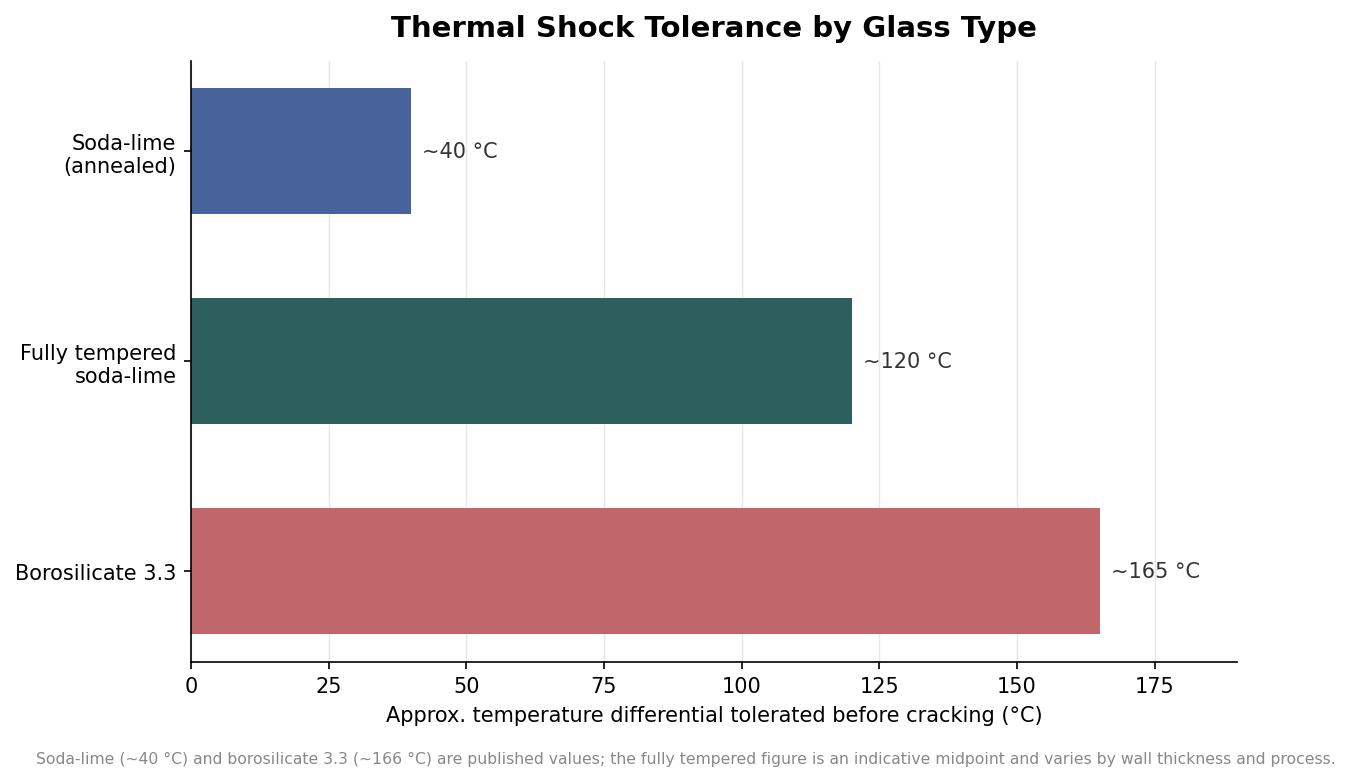
Roughly nine out of ten glasses you handle are soda-lime, and the recipe has barely changed in a century: about seventy percent silica with soda and lime making up most of the rest. It is inexpensive, easy to mold into almost any shape, and perfectly clear enough for everyday branded barware. Its weakness is thermal shock. Annealed soda-lime tolerates a temperature swing of only around forty degrees Celsius before it risks cracking, which is why an ordinary glass can fail when boiling water hits a cold wall. For cold and ambient service, promotional giveaways, and general retail glassware, soda-lime is the sensible default and the benchmark every other material is priced against.
Fully tempered: the foodservice workhorse
Tempering does not change the recipe; it changes the stress state. A finished soda-lime glass is reheated and rapidly cooled so the surface locks into compression, which makes it several times more resistant to mechanical impact and meaningfully better under thermal stress than the same glass annealed. This is why busy bars and restaurants specify fully tempered tumblers and pint glasses that survive being stacked, dropped, and run through commercial dishwashers thousands of times. Tempered glass also fails differently: instead of long dangerous shards it breaks into small blunt pieces, a safety advantage in a service environment. The trade-off is that tempering adds cost and that a tempered glass cannot be cut or re-worked after the fact, so decoration has to be planned around the finished piece.
Borosilicate: the thermal-shock champion
When glass has to move between hot and cold without complaint, borosilicate is the answer. Adding boric oxide, roughly thirteen percent in the classic Type 3.3 formulation alongside about eighty percent silica, drops the coefficient of thermal expansion to about 3.3 by ten-to-the-minus-six per Kelvin, roughly a third of soda-lime’s. In practical terms, Type 3.3 borosilicate can absorb a temperature differential on the order of 165 degrees Celsius before fracturing, compared with about forty for ordinary soda-lime. That is why it dominates double-walled mugs, French presses, tea glasses, and anything meant to hold espresso, mulled wine, or a hot toddy. Borosilicate is lighter and clearer than many people expect and has a clean, modern look, but it costs more than soda-lime and is less common in high-volume promotional lines, so it is worth specifying only when hot service or thermal cycling is genuinely part of the use case.
Crystal and lead-free crystal: the premium tier
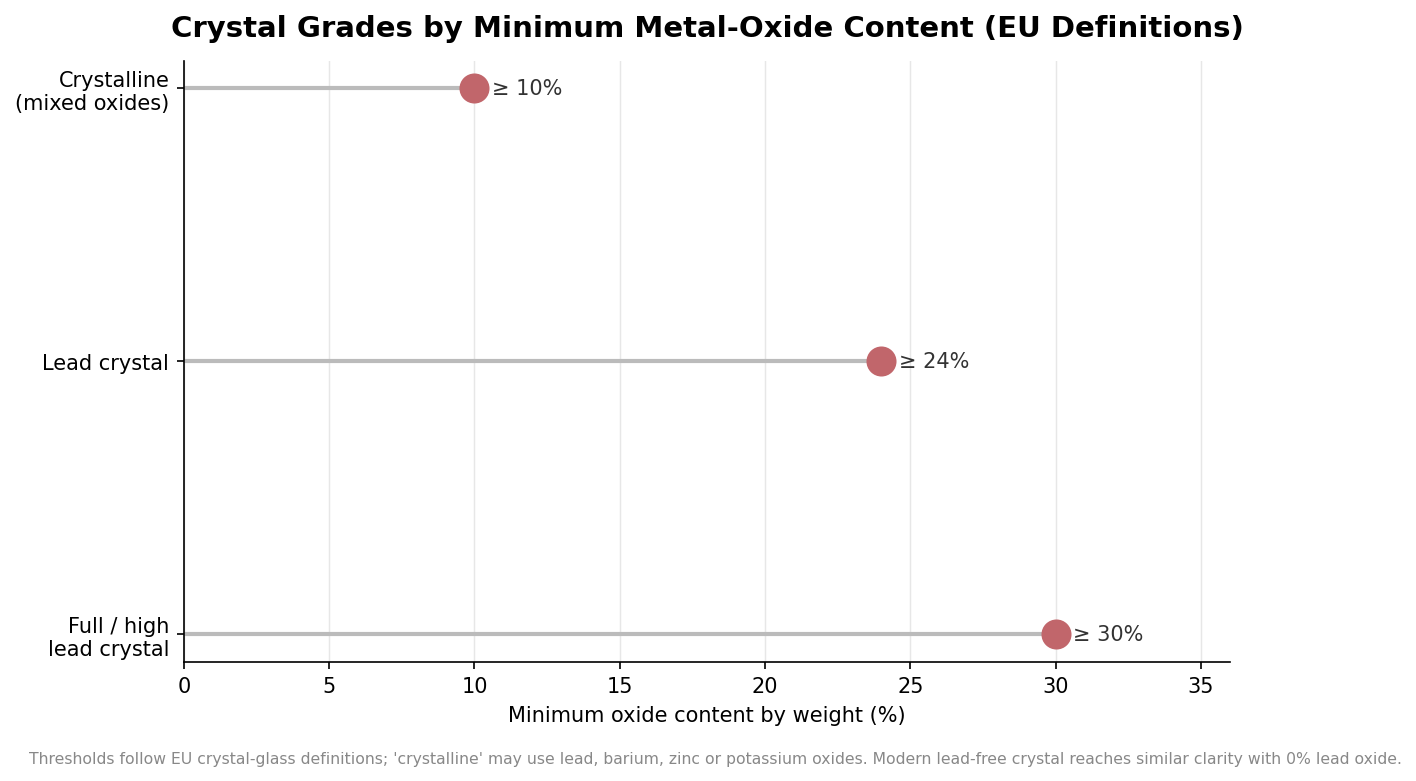
Crystal is what people reach for when brilliance and weight signal quality: wine glasses with thin, light bowls, spirits tumblers with heavy bases that throw sparkle across a table. The clarity and refraction come from adding metal oxides to the melt. Under the long-standing European definitions, crystalline glass carries at least ten percent oxide content, traditional lead crystal at least twenty-four percent lead oxide, and full or high lead crystal thirty percent or more. Lead crystal is softer than soda-lime, which lets cutters carve deep decorative facets, but that softness also means it scratches more easily and is usually hand-wash only. The important modern development is lead-free crystal, which substitutes barium, zinc, and potassium oxides to reach comparable clarity and refraction with zero lead, and is typically dishwasher-safe and food-safe. For branded gift glassware and premium retail, lead-free crystal usually delivers the look buyers want without the care burden or the lead question.
How material shapes decoration and dishwasher life
Material does not just decide durability; it constrains how you brand the glass and how long that branding survives. Softer, thicker soda-lime and tempered pieces are the friendliest canvases for the two workhorse decoration methods, ceramic (organic) ink printing that is kiln-fired for dishwasher permanence and deep acid or sandblast etching. Crystal’s softness makes it beautiful to cut but means printed decoration can wear faster under repeated washing, so etching or a fired enamel often ages better on premium pieces. Borosilicate’s low expansion is an advantage during the firing step used to cure printed inks. Whatever the material, the durability rule is the same: a decoration that is fired into or cut into the glass will outlast one that merely sits on the surface, and the fade complaints that dog cheap branded glassware almost always trace back to a low-temperature print skipping that fired step.
Matching material to the job
Work backward from service conditions and budget. Cold and ambient promotional glassware, and most high-volume retail barware, is soda-lime. A bar or restaurant that will abuse its glasses daily wants fully tempered. Anything that holds a hot drink or cycles between temperatures should be borosilicate. Gift-grade, display, and premium spirits glassware belongs in lead-free crystal, reserving traditional lead crystal for hand-washed decorative pieces where deep cutting is the point. The figures here are representative industry values rather than guarantees for any one factory, so confirm the exact grade, tempering, and decoration process on a sample before you commit a full run, and let the way the glass will actually be used, rather than the lowest unit price, drive the material you specify.