A custom logo looks sharp on almost any glass, but the shape you print it on changes how the beer pours, smells, and holds its head far more than most buyers expect. If you run a taproom, plan events, or order branded drinkware for a brand, choosing the glass style first and the artwork second is what separates a piece people take home from one that ends up in a donation box. This guide walks through the main beer glass styles, what each one does for the beer inside it, and how to match a decoration method to the shape you land on.
Match the glass to what you pour
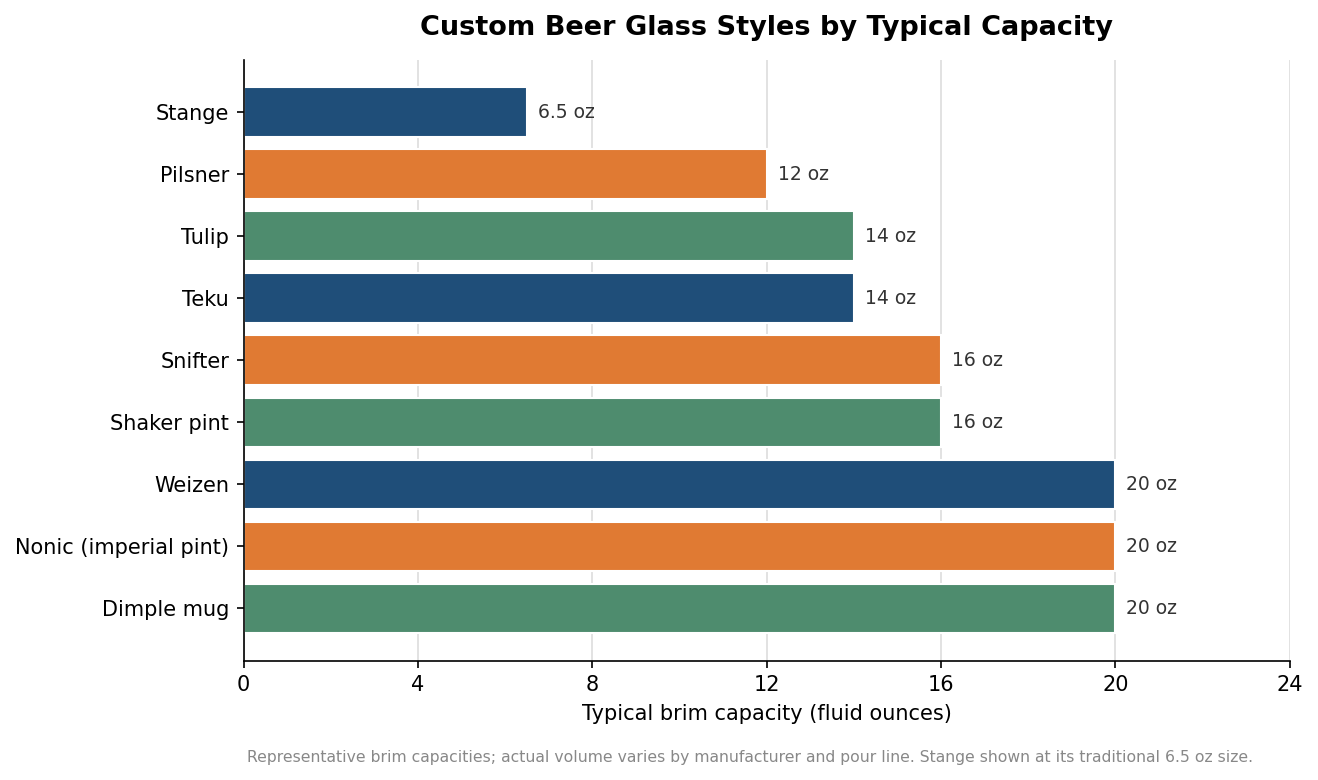
Capacity is the first filter, not an afterthought. A 16-ounce shaker pint and a 6.5-ounce stange are both “beer glasses,” yet they suit completely different pours. Serving a 9% imperial stout in a 20-ounce mug encourages a heavy pour that warms and flattens before the last sip; serving a crisp 4.8% lager in a tiny stange means refilling constantly. The capacities below are representative brim volumes, and real glasses vary by a few ounces between manufacturers and by where the fill line sits, but they give you a reliable way to group styles before you ever look at artwork.
Once you know roughly how much liquid a style holds, the rest of the decision is about aroma, head retention, and how the glass feels in the hand. Those factors sort the styles into three practical families.
Everyday pours: the pint, nonic, and dimple mug
The American shaker pint is the workhorse of the category. At 16 ounces with straight, tapered sides, it stacks tightly, survives a busy bar, and costs less to buy and to decorate than almost anything else. Its flat sides are also the easiest canvas for a large screen-printed logo. The trade-off is that it does little for aroma, which is why it is a poor match for hop-forward or high-alcohol beers.
The nonic imperial pint holds closer to 20 ounces and adds a bulge a couple of inches below the rim. That ridge improves grip, keeps glasses from sticking when stacked, and protects the rim from chipping, which matters if the glass will live in a rental kitchen or event bin. The dimple mug pushes the same roughly 20-ounce volume into a heavy, handled design; the dimples add grip and hide wear, and the thick walls take abuse well, though the curved surface makes a clean single-pass print harder to achieve.
Aroma and head retention: tulip, snifter, IPA, and weizen
These shapes exist to concentrate what you smell. A tulip glass, around 14 ounces, flares at the lip to trap froth and funnel aroma upward; it flatters Belgian ales, sours, and barleywines. The snifter has a similar job for the strongest beers: its brim capacity is roughly 16 ounces, but you pour it half full so there is room to swirl an imperial stout or barleywine and release its aroma. An IPA glass uses a bell or ridged shape near the top to push hop aroma toward the nose while a narrower base keeps the beer cold.
The weizen glass is the tall outlier of this group, holding about 20 ounces because a proper hefeweizen throws a large, persistent head that needs somewhere to go. Its curved profile supports that head instead of letting it collapse. All four of these shapes are stemmed or curved, which has real consequences for decoration that we will come back to.
Slim and specialized: pilsner, stange, and teku
Slim glasses sell the look of the beer. A pilsner glass, commonly around 12 ounces, is tall and narrow so it shows off clarity, color, and a steady column of carbonation; it suits pilsners, blonde ales, and pale lagers. The stange is smaller still at a traditional 6.5 ounces, a straight cylinder from Cologne built for delicate styles like kolsch and altbier that are meant to be drunk fresh and refilled often.
The teku, near 14 ounces on a stem, has become the default tasting glass for many craft breweries because its angled rim works across an unusually wide range of styles, from saisons to stouts. If you want one branded glass that photographs well and handles a varied tap list, the teku is the safest single choice, though its stem and curve make it one of the harder shapes to decorate cheaply.
Match the decoration to the glass you picked
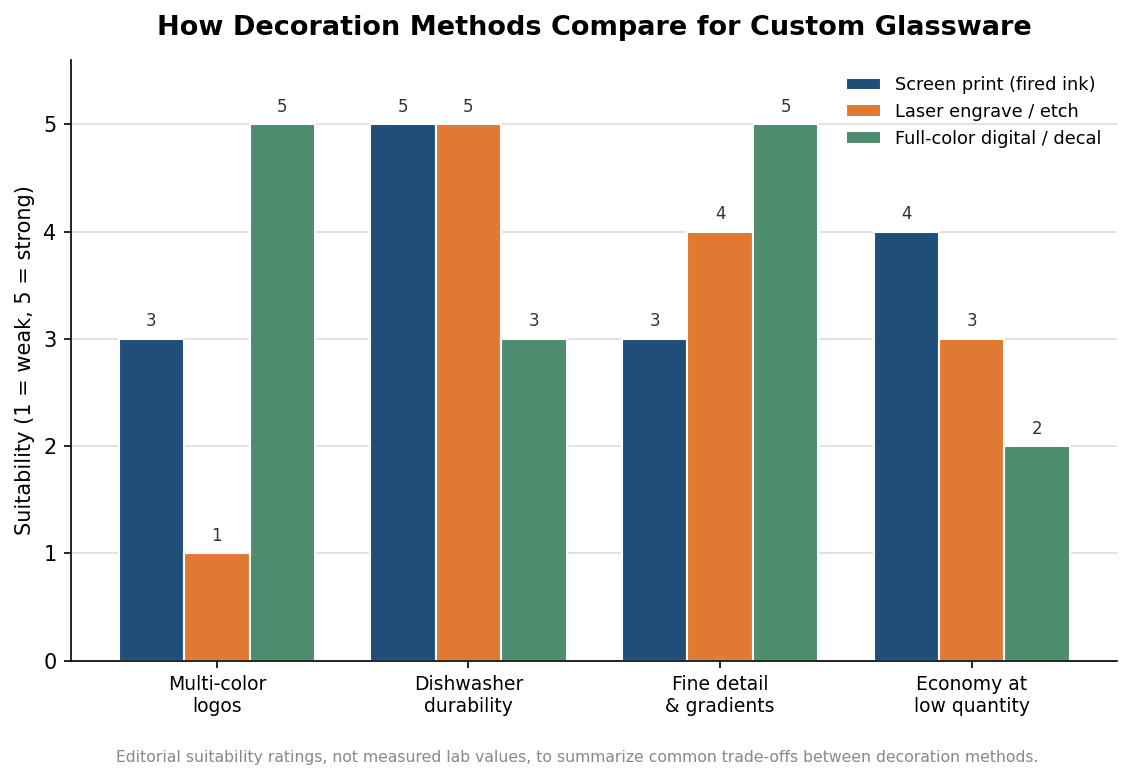
The shape you choose narrows your decoration options. Screen printing with fired ceramic ink is the standard for logos: it lays down one color per screen, so a two-color mark needs two passes, and shops typically ask for a minimum around 24 to 72 pieces plus a screen setup fee in the range of forty to sixty dollars per color. Properly flame-treated and cured, a screen print holds up to repeated dishwashing. Laser engraving, or etching, cuts a permanent frosted mark into the glass; it carries no color and reads as a single tone, but it never fades and shrugs off any dishwasher. Full-color digital printing and applied decals handle gradients and photographs that the other two methods cannot, at the cost of lower dishwasher durability unless the decal is kiln-fired.
Curved and stemmed glasses change the math. Straight-sided pints and pilsners are the easiest and cheapest to print a large logo on, because the screen meets a flat surface. Tulips, tekus, snifters, and weizens curve away from the screen, so a big wrap print distorts; on those, a smaller mark, a laser engraving, or a decal usually looks better. Plan on roughly two to four weeks of production for a decorated bulk order, and longer in the fourth quarter when holiday demand backs up every decorator. Whatever you choose, order a single decorated sample before committing to several hundred pieces, because color, placement, and how the artwork sits on a curve are far easier to judge in your hand than on a screen.